
A Forgotten King...
If you have used technology in the last 30 years, you have used a JPEG (Joint Photographic Experts Group) image before. It's the standard that the majority of the web uses for its images, mainly due to its decent enough compression and wide support among web browsers.
JPEG came out in 1992,[8] and a lot has changed since then. The web has gotten a lot bigger and more complicated. Websites like Google, Instagram, and YouTube have so much complexity under the hood that the amount of code shipped to the user's browser is getting larger and larger by the day. So why hasn't JPEG found its successor yet?
It has! It's called JPEG XL. Check it out below:
If I had to guess, you probably don't see anything. Unless you're on Safari, all you'll see is a black border. So why is this?
Some Background...
Before we dive into explaining JPEG XL, we need to understand JPEG itself.
JPEG is a lossy compression algorithm.[7] This means that when you save a JPEG, some of the data is lost on purpose. This is why you can't uncompress a JPEG and get back the original image.
This is done because it allows for greater compression than lossless formats, like PNG.[10]
When you're viewing photos on the web, you want to speed up loading times. The smaller the image files being served to the user, the quicker your website will load. Oftentimes, it's better to sacrifice a bit of quality to decrease the load on bandwidth.
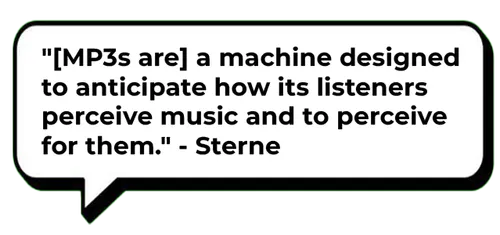
It's done intelligently though. For a point of reference, MP3s compress audio by attuning its data to the characteristics of the human ear. They reduce the sound to only include frequencies that can be reasonably interpreted by the human ear.[4]
In the same way that MP3s prune out frequencies indetectable by humans, JPEGs try to remove unnecessary gradients in images. Our brains are notoriously bad at viewing dark colors, and JPEG exploits this by mashing dark shades together in a process called quantization[11].
JPEGs also discard high frequency information. Subtle changes in texture, like the stitching of fabric or the chips made in wood, can be intelligently blurred to give the illusion of keeping their fidelity, even when much of that information is lost.
Crafting a Better JPEG
As you would imagine, many algorithms have come out that have threatened to dethrone JPEGs dominance in the internet zeitgeist.
Pioneered by Apple, the HEIC format is one of the most popular alternatives, in large part due to the market share they have nabbed with the iPhone. WebP is another standard that has arisen, supported by Google. It has seen widespread adoption since 2020, and is a great option for developers who want to keep their web applications trim and efficient.
But these formats have historically suffered from a lack of support in a variety of apps. HEIC is very expensive to license,[12] so Apple is really the only company that can reasonably support it. Additionally, while WebP support is growing in browsers, it is less useful as a generalized file format since it won't open natively in Windows and MacOS. Ultimately, JPEGs cultural dominance is exactly what makes it so irreplaceable.
JPEG XL is the first new format to challenge JPEG's dominance in decades. While JPEG has seen incremental updates in JPEG 2000 and JPEG XR, JPEG XL is the first new format to pose a legitimate challenge to JPEG's dominance in decades.
JPEG XL can do a lot. It can re-encode existing JPEG images, reducing their file size without re-introducing artifacts.[6] As such, it is the only new file format that remains backwards compatible with the preexisting JPEG format. And it's completely royalty-free despite these fancy re-encoding schemes. Pretty cool!
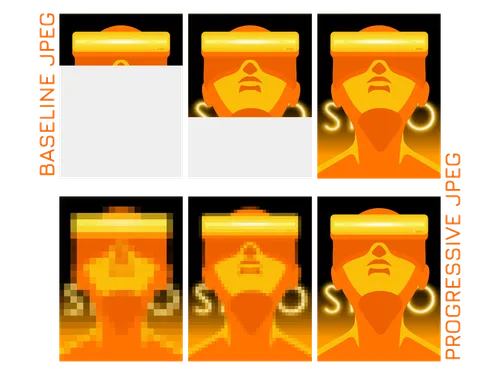
It also supports native Progressive Decoding, which allows for the image to be displayed before it is fully decoded. Traditionally, images are loaded in from top-to-bottom, rendering the rows of pixels one at a time. With progressive decoding, images will load at a set of "tiers", each being a progressively more detailed version of the image. Additionally, machine learning is used to prioritize important elements of a given image, like faces or areas that are in sharp focus relative to the rest of the image.
Additionally, it's just better at compression in general. While WebP can compress images to 25-34% smaller size[13] than an equivalent JPEG, JPEG XL promises a 60% reduction[5] in filesize, while preserving JPEG-tier quality.
So... if JPEG XL is so great, why isn't it more popular?
Google.
The boogeyman is back. Google has been the biggest obstacle to JPEG XL's adoption due to its monopoly on the browser market.
Google has been a major driver of the web, and its browser, Chrome, is the most popular browser in the world. If Google doesn't support a format, then it doesn't stand a chance.
Google has been vocal about its support for its new standard, AVIF. It is the image component of their new video codec that they are devising to improve compression ratios on YouTube, AV1. As such, Google has a vested interest in AVIF's success.
And AVIF is not bad by any means. It's a great format. It can support 4096 shades of colors per color channel, 8192 x 4352 images, is royalty-free, can handle transparency, and has a host of other features that make it a great option.[1] However, JPEG XL is just more future-proof. It can support 4 billion shades of each color, and can support pixel dimensions up to a billion pixels of width and height.[3] If AVIF is a gun, JPEG XL is a rocket launcher.
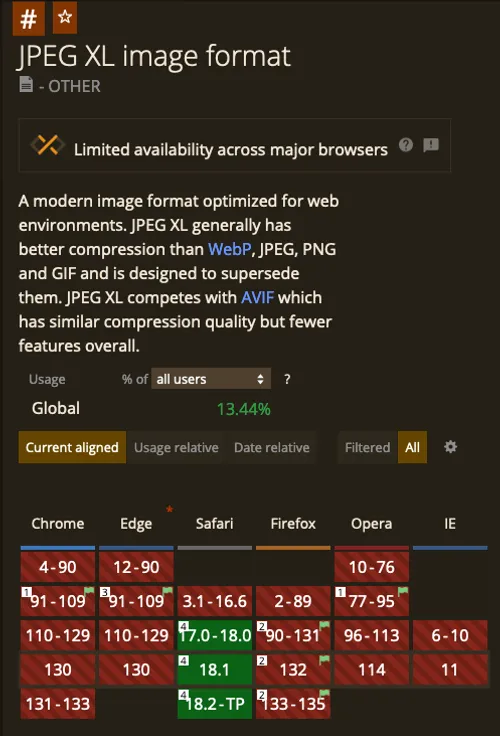
So Google's technological politics serve as a bulwark to JPEG XL's success. They dropped support for JPEG XL in Chrome back in 2023 due to a lack of "sufficient incremental benefits",[2] and Mozilla (a company funded by Google) chooses to remain "neutral" on the issue by only enabling it in its nightly builds.[9]
The only browser that supports JPEG XL is Safari. And while it's great that Apple is supporting the format, Safari doesn't have the market share for web developers to justify using it, especially when Google-sponsored formats like WebP and AVIF seem to do the job well enough.
It's quite a shame. JPEG XL is a great format that has the potential to completely dethrone JPEG as the universal image format. But until Google and Mozilla change their tune, JPEG XL will remain a niche format, relegated to living in the shadow of AVIF.
Works Cited
AVIF Specification - AOM Media Codec
Chrome Dropping JPEG XL Support - Phoronix
How JPEG XL Compares to Other Image Codecs - Cloudinary
How the MP3 helped bring the music industry to its knees - The Verge
JPEG XL Call for Proposals - Joint Photographic Experts Group
JPEG XL Re-encoding Discussion - GitHub
JPEG Standard (ITU-T81) - W3C
JPEG: 25 Jahre und kein bisschen alt - Heise Online
Mozilla's Neutral Stance on JPEG XL - Phoronix
PNG File Description - Golden Software
An Introduction to MPEG Video Compression - John Wiseman
HEVC Advance Royalty Rates Summary - Web Archive
WebP Compression Study - Google Developers